About the project
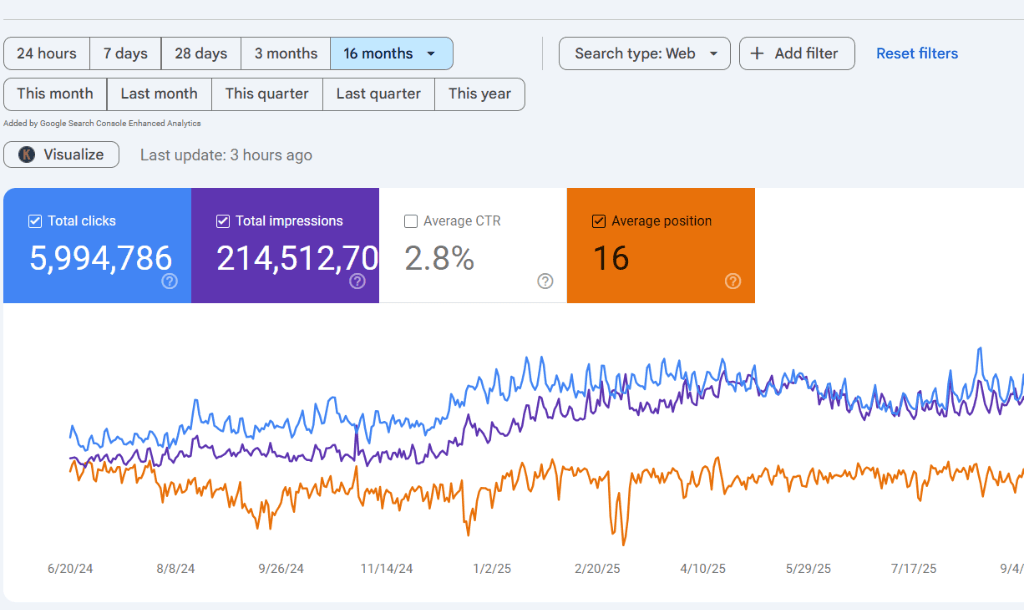
The client is a large luxury marketplace whose main market is the United States. The site already had serious search traffic: Google Search Console showed 5.99 million clicks and 214 million impressions over 16 months. It does not run on a standard CMS: pages are generated from templates, formulas and a dynamic structure, so one change applies to thousands of pages at once. I directed the technical SEO as the only SEO specialist at a digital marketing agency, and coordinated every change with the agency's developers. It was the largest project I have worked on.
The challenge
On a site with thousands of generated pages, every problem repeats at scale. The audit found that many pages did not match the intent of the people searching for them, and that technical errors were wasting Google's crawling.
Search intent not targeted on most pages
Many pages were not aimed at what searchers actually wanted: titles, headings and content did not match the intent behind the queries they appeared for.
Titles and H1s that did not agree
On core pages, the title tag and the H1 heading described the page in different ways, sending Google mixed signals.
Canonical errors and 404s
Google Search Console reported canonical issues, and the crawl found 404 pages and URLs with no response. Listing pages did not declare themselves as the main version of their URL, so Google had to guess which version to rank.
Other crawl issues and outdated structured data
Screaming Frog surfaced broken internal links and other issues, and the Schema.org markup needed updating.
What I did
Search intent, at template level
I realigned titles, H1s and on-page content with search intent. Because pages are generated from templates and formulas, each fix applied to thousands of pages.
Search Console and crawl errors
I fixed most of the issues reported in Google Search Console, including canonical errors and 404s, plus the issues found with Screaming Frog. Listing detail pages now carry a self-referencing canonical.
Structured data and internal links
I updated the Schema.org markup and reworked internal linking so more link value flows to the most important pages.
URL structure for the new platform
The client was building a new version of the platform. I wrote a detailed document recommending the URL structure to use, comparing flat and nested (structured) URLs, so the new version would launch on a sound base.
Working with the developers
Since the site has no CMS, every change went through the agency's development team, and I coordinated each one with them.
Measurement
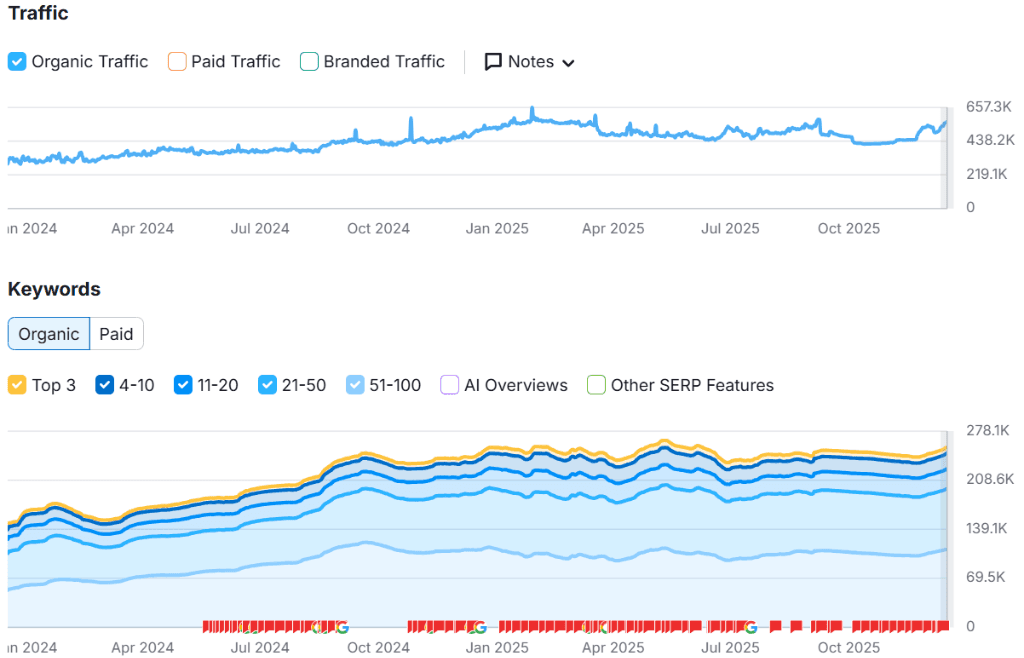
Organic traffic and ranked keywords were tracked in Semrush on U.S. data, alongside Google Search Console.
Screenshots

What a similar business can take from this
- On a templated site, fix the template, not the page. One corrected formula fixes every page built from it, which is how thousands of pages were improved.
- Plan the URL structure before a platform rebuild. Changing URLs after launch means redirects, lost signals and months of recovery.
- Small percentages are big numbers at this size. A 6% gain on a site at 562.8K monthly organic visits is roughly 30,000 more visits a month.